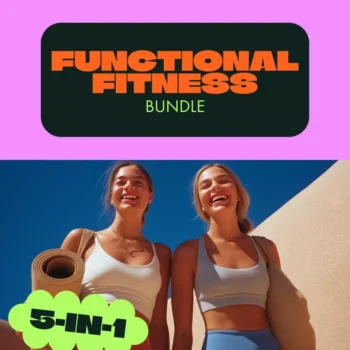
Functional fitness is about building strength, mobility, and stamina that carry over to daily life—lifting, reaching, walking, and moving with control. This 5-in-1 bundle combines step-by-step guides, eBooks, and checklists designed to help structure training, track consistency, and progress safely with a practical, everyday approach.
Functional fitness focuses on training the patterns the body uses outside the gym, so strength shows up where it matters: at home, at work, and during weekend projects.
For general health benchmarks and activity basics, it’s also helpful to reference trusted guidance like the CDC’s Physical Activity Basics and the NIH MedlinePlus overview of exercise and physical fitness.
The strength of a bundle like this is that it reduces guesswork. You get learning material (so you understand what you’re doing) plus action tools (so you actually do it on busy weeks).
| Component | Best for | How it helps day-to-day |
|---|---|---|
| Guides | Getting started and staying organized | Turns a broad goal into a sequence of doable sessions |
| eBooks | Understanding technique and structure | Improves confidence with movement choices and pacing |
| Checklists | Consistency and tracking | Keeps warm-ups, main work, and recovery from being skipped |
| Progress references | Adjusting week to week | Supports gradual overload without guesswork |
| Routine templates | Busy schedules | Makes short sessions feel complete and purposeful |
If you want the all-in-one set, you can find it here: The Everyday Functional Fitness Program 5-in-1 Bundle: Guides, eBooks & Checklists for a Stronger You.
Instead of treating the bundle like five separate downloads, use it as a simple loop: learn the pattern, run the session, track it, and progress one small step at a time.
For resistance-training best practices and progression principles, the American College of Sports Medicine (ACSM) guidance is a strong reference point.
A consistent “same-but-slightly-better” week beats a perfect plan that’s hard to repeat. The flow below keeps the focus on foundational patterns while leaving room to scale up or down.
| Day | Primary focus | Keep it functional by prioritizing |
|---|---|---|
| Mon | Lower body + core | Squat/hinge pattern, stable spine, controlled tempo |
| Wed | Upper body + posture | Push/pull balance, shoulder positioning, smooth reps |
| Fri | Full body | Good form under mild fatigue, steady breathing, safe ranges |
| Tue/Thu | Light activity | Steps, gentle mobility, recovery habits |
| Weekend | Optional session | Technique practice or easy conditioning |
For an add-on that leans into downshifting and restoring, pair training days with Yoga Techniques for Full Relaxation and Recovery: 4-in-1 Digital Download Bundle.
Yes. The guides and checklists provide a clear starting point, so beginners can focus on foundational movement patterns and progress conservatively. If you have medical concerns or a recent injury, consult a qualified professional before starting.
Most people do well with 2–4 strength-focused sessions per week, depending on schedule and recovery. On off-days, add light activity like walking or easy mobility to stay consistent without overdoing intensity.
No. Many functional patterns can be trained with minimal equipment and smart progressions, emphasizing control and range of motion. Optional tools like resistance bands, dumbbells, or a kettlebell can expand variety over time.






Leave a comment