AI for Small Business Toolkit: A 5-in-1 Workflow Bundle Built for Real-World Execution
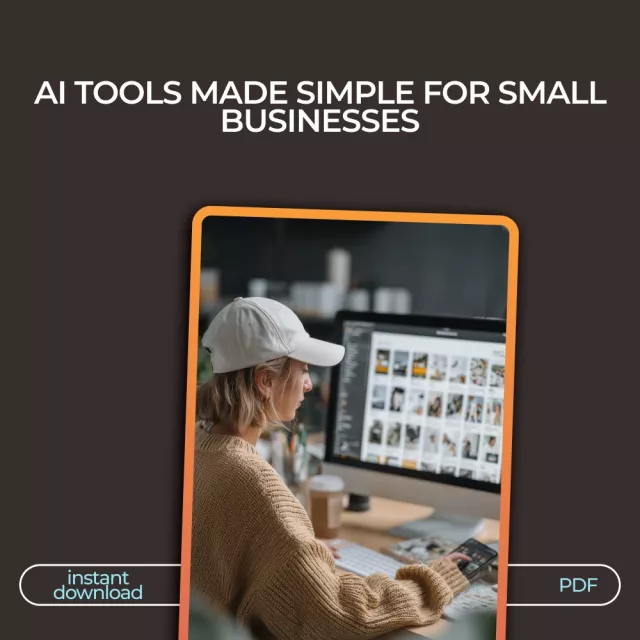
Small businesses rarely need more apps—they need repeatable workflows. The AI for Small Business Toolkit – 5-in-1 Digital Download Bundle is built to turn everyday business tasks into clear, reusable processes, so you can move from “blank page” to consistent output across marketing, sales, customer support, and operations. Instead of reinventing the wheel every time you launch an offer, answer a customer, or train a new hire, this bundle helps you standardize what “good” looks like—and ship it faster.
What the 5-in-1 bundle is designed to solve
Most bottlenecks in small teams aren’t caused by lack of effort—they’re caused by unclear starting points and inconsistent execution. A structured toolkit helps eliminate that friction.
- Reduces time spent drafting everyday business content (emails, posts, offers, policies, FAQs).
- Improves consistency across customer touchpoints with standardized frameworks and templates.
- Helps non-technical teams apply AI tools with structured inputs instead of trial-and-error.
- Creates a repeatable system for ideation, drafting, reviewing, and publishing.
- Supports lean teams that need to ship faster without sacrificing clarity or brand alignment.
What’s included and how each piece can be used
The bundle is organized around practical business functions so you can plug it into your week without a complex setup. Think of it as a “working set” of workflows: define inputs once, reuse the frameworks repeatedly, and refine as you learn what performs best.
- Core playbooks and templates that turn common tasks into step-by-step workflows.
- Frameworks for marketing assets: landing page sections, ad angles, short-form social captions, and content calendars.
- Sales support materials: discovery questions, objection-handling scripts, follow-up sequences, and proposal outlines.
- Customer support assets: response macros, escalation rules, refund/return language, and customer-friendly troubleshooting steps.
- Operations templates: SOP outlines, meeting agendas, role scorecards, and simple KPI tracking formats.
Example outcomes from the toolkit (by business function)
| Business area |
Typical use case |
Example deliverables created with templates |
| Marketing |
Launch a new offer quickly |
Offer positioning, landing page outline, email sequence, ad angles |
| Sales |
Improve follow-up consistency |
Follow-up cadence, call notes template, objection replies, proposal skeleton |
| Customer support |
Reduce response time |
FAQ responses, ticket macros, escalation checklist, policy snippets |
| Operations |
Standardize repeatable tasks |
SOP templates, weekly metrics tracker, meeting agenda, handoff checklist |
Who it’s best for (and who may not need it)
This bundle is most valuable when your business produces a steady stream of customer-facing communication and internal documentation—and you want it to sound like “one company,” not five different drafts.
- Best for: solo founders and small teams that create content, proposals, and customer responses frequently.
- Best for: service businesses, online businesses, and local businesses building repeatable lead generation.
- Best for: teams that want structure—templates, checklists, and workflows—rather than experimenting from scratch.
- May be less useful for: companies with fully documented SOP libraries and dedicated copywriting resources.
- May be less useful for: businesses seeking a done-for-you agency service rather than DIY assets.
How to implement the toolkit in the first week
A fast rollout works best when you keep scope tight. The goal is to create one visible win (speed, consistency, or quality) and then expand.
- Day 1: Choose one business goal (more leads, better conversion, faster support) and pick only the templates that match it.
- Day 2: Define inputs once—offer, target customer, primary pain points, proof, policies—so drafts stay consistent.
- Day 3: Build a simple review checklist (accuracy, tone, legal/policy alignment, formatting) before publishing anything.
- Day 4: Create a “reuse library” folder for best-performing outputs (emails, posts, scripts, macros) and label them by scenario.
- Day 5–7: Track one metric per function (reply time, lead volume, conversion rate, sales cycle length) to validate improvements.
Using AI responsibly: accuracy, privacy, and quality control
Workflow speed only matters if the output is accurate, compliant, and on-brand. A simple governance routine prevents costly mistakes. For general guidance, the NIST AI Risk Management Framework (AI RMF 1.0) is a helpful reference for balancing usefulness and risk, and the FTC’s advertising guidance outlines expectations for truthful marketing claims.
- Accuracy: verify claims, prices, dates, policies, and any business-critical statements before sending or publishing.
- Privacy: avoid pasting sensitive customer data, payment information, or confidential contracts into AI tools.
- Ownership and compliance: ensure final outputs match brand guidelines and meet advertising and consumer-protection expectations.
- Human-in-the-loop review: set a minimum standard for approving customer-facing copy and support responses.
- Process over perfection: prioritize a repeatable workflow—draft, review, publish, measure, refine.
Common ways small businesses get value from a digital workflow bundle
When templates are organized by business function, they’re easier to reuse under pressure—during launches, busy seasons, staffing changes, and sudden spikes in support tickets.
Featured digital downloads
FAQ
How quickly can the toolkit be put to use after purchase?
Because it’s a digital download, it can be used the same day. For the fastest results, start with one goal and a small set of templates, then expand once you’ve created a few reusable “best versions.”
Does it require advanced AI or technical skills?
No—it’s designed for non-technical users who want guided templates and structured inputs. Basic familiarity with common AI writing tools is typically enough to put the workflows into action.
How should customer data be handled when using AI templates?
Avoid entering sensitive personal data, payment details, or confidential information. Use anonymized examples and keep a review step to confirm accuracy, policy alignment, and compliance before anything is sent or published.
Recommended for you







Leave a comment