
When goals feel scattered or motivation fades quickly, the missing piece is often alignment—knowing what matters most and translating it into decisions that fit real life. AI can help organize reflections, surface patterns, and turn vague intentions into practical next steps. This guide walks through a values-to-goals workflow and shows how a downloadable workbook can speed up the process while keeping it personal and grounded. For more guidance, see A Framework of Fundamental Values for Human-AI Alignment – arXiv.
Alignment isn’t a single “aha” moment—it’s the ongoing pattern of choosing in a way that matches your priorities across time. It shows up in ordinary decisions: what you say yes to, what you protect on your calendar, and what you stop apologizing for needing. For further reading, see AI in Personal Life – The Future is Now – Milne Publishing.
When goals reflect both meaning (the why) and constraints (the reality), follow-through becomes less about willpower and more about fit.
AI works best as a mirror, not a judge. It can help you notice what you keep repeating, what you keep avoiding, and where your stated priorities don’t match your lived schedule.
One practical rule: if a value label feels “nice” but doesn’t change what you do on a Tuesday, refine it until it does.
The following sequence keeps the process grounded. It turns reflection into decisions, and decisions into small, repeatable actions.
List recent moments of pride, frustration, envy, and relief. Each emotion points toward a value: pride shows what you want more of; frustration shows what’s being violated; envy shows what you crave; relief shows what you needed.
Label 5–8 core values in simple language (for example, “steady health energy,” “creative craft,” or “financial breathing room”).
Write what each value looks like as behavior: what it is and what it isn’t. This is where boundaries come from.
Rank values for your current season of life. Priorities shift with caregiving, career phases, health, and relationships—and that’s normal.
Create 1–2 goals per top value, then add success criteria and constraints. If helpful, borrow a SMART structure for clarity (see MindTools’ overview of SMART goals).
Choose weekly actions that are small enough to repeat and measurable enough to track.
Do a short weekly check-in to adjust actions—not abandon the value. The value stays; the tactic changes.
| Core value | Goal example | Weekly action | Simple metric |
|---|---|---|---|
| Health energy | Improve daily stamina | 20-minute walk 4x/week | 4 walks completed |
| Learning | Build a new skill over 8 weeks | Two 30-minute study sessions | 60 minutes logged |
| Connection | Be more present with loved ones | Phone-free dinner 3 nights | 3 dinners completed |
| Craft/quality | Deliver better work with less stress | Plan tomorrow’s top 3 tasks | Top 3 written nightly |
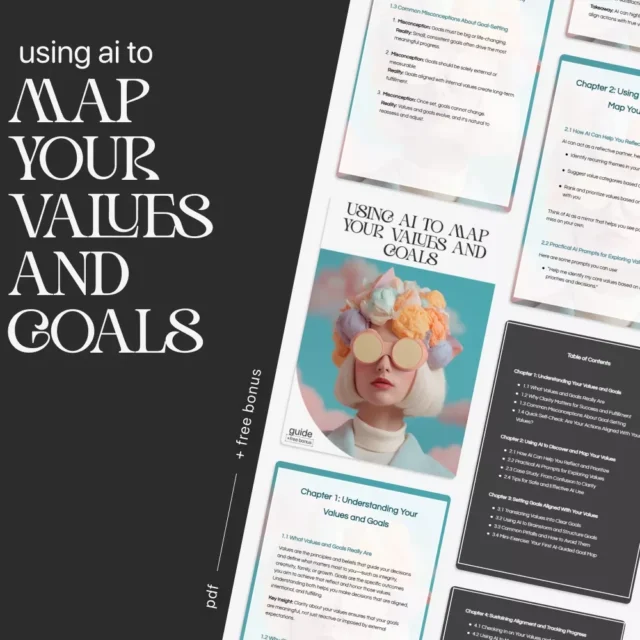
If a repeatable system would help, Using AI to Map Your Values and Goals (digital workbook download) is designed as a personal growth guide and goal-setting workbook you can revisit across life seasons. It’s best for anyone who wants a clear bridge between values, goals, and daily actions.
For a structured relaxation option, consider the Guided Imagery Toolkit for Sleep and Relaxation, a guided bundle designed to make wind-down routines easier to repeat during stressful weeks. Keep the routine simple: pick one track or exercise, run it at the same time nightly, and treat it as part of your “alignment infrastructure,” not another task to perfect.
AI can summarize patterns from your real-life examples, but accuracy depends on how specific and honest those examples are. Treat the output as a draft you edit—your values should feel true in your day-to-day decisions, not just sound good on paper.
Values are ongoing principles (how you want to live), while goals are time-bound targets (what you want to achieve). Goals can change as life shifts, but they work best when they clearly serve a value you want to express consistently.
Review weekly to adjust actions and keep momentum, and do a deeper alignment check monthly or quarterly to re-rank priorities. Major life changes often require a new “season” ranking even if your core values stay similar.






Leave a comment