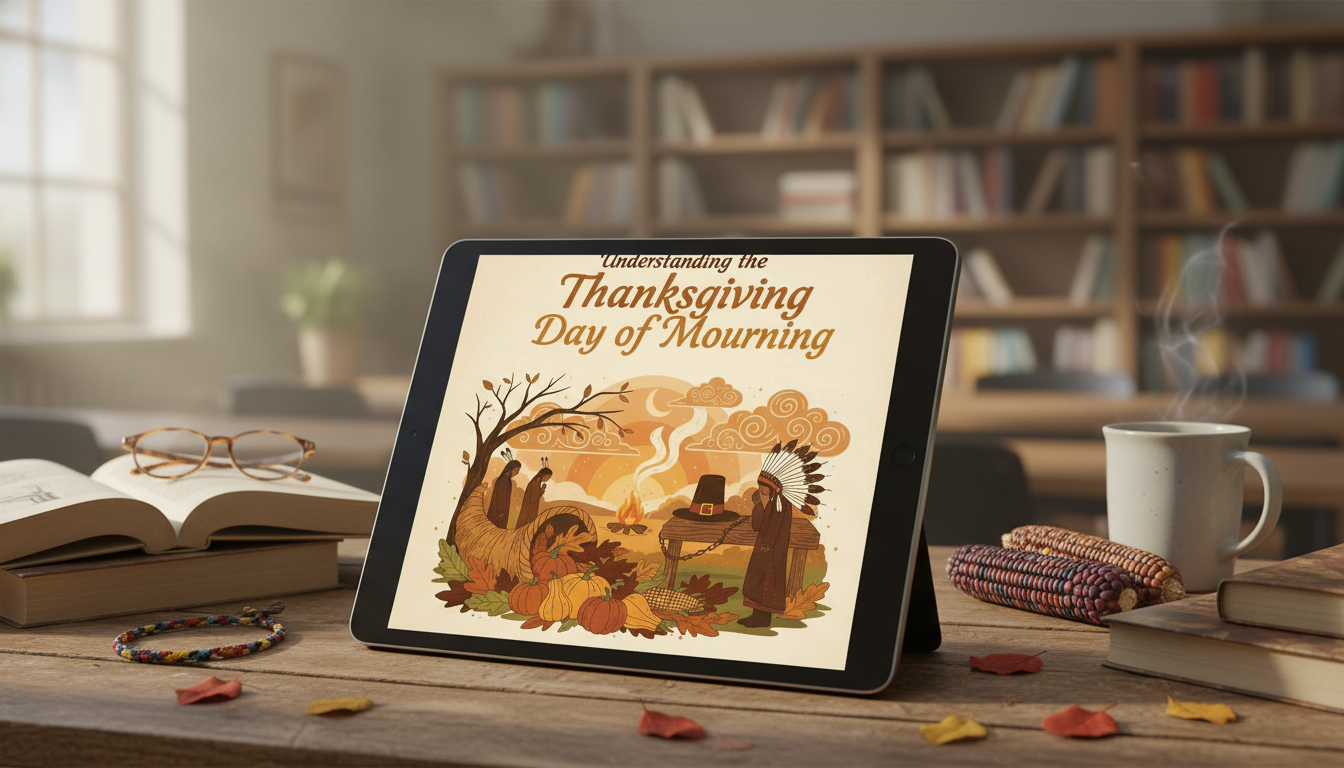
The Thanksgiving Day of Mourning is observed by many Indigenous people and allies as a time to remember the impacts of colonization, honor Indigenous resilience, and challenge simplified holiday narratives. For educators and learners, it offers a thoughtful entry point into primary sources, civic dialogue, and culturally respectful learning—without reducing Indigenous histories to a single day or a single story.
The Thanksgiving Day of Mourning is an annual observance that centers Indigenous perspectives on the history and legacy of colonization in what is now the United States. It is often associated with gatherings, speeches, and community-based actions that emphasize remembrance, resistance, and survival.
In learning settings, the Day of Mourning can function as a framework for truth-telling and accountability: students practice asking who is speaking, what is being left out, and how public memory is shaped. It also reinforces a crucial point for respectful teaching—Indigenous nations are present-tense communities with living cultures, governments, and ongoing relationships to land, not only historical subjects.
Many classroom Thanksgiving stories focus on a celebratory “origin” that is easy to retell. The Day of Mourning invites learners to hold a wider historical context: conflict, displacement, and treaty violations alongside moments of cooperation and exchange. The goal is not to force a single conclusion, but to support critical thinking grounded in evidence and multiple perspectives.
This approach also helps students examine how national myths form and spread—through textbooks, seasonal crafts, children’s literature, film, and family traditions. When students learn to notice whose voices are amplified and whose are missing, they develop transferable skills for civic learning and media literacy.
| Topic | Simplified framing | More complete framing |
|---|---|---|
| Early encounters | A friendly meal that defines the holiday | Complex relationships shaped by power, land, and differing worldviews |
| Indigenous peoples | A single group in the past | Diverse sovereign nations with ongoing cultures and political realities |
| Land and settlement | A story of pioneers and progress | A story that includes dispossession, forced removals, and resistance |
| Sources | Retellings and traditions | Primary sources, tribal resources, and multiple perspectives |
Strong lessons begin with place-based specificity. Identify the Indigenous nations connected to the land where learning occurs, and use tribally preferred names whenever possible. This avoids pan-Indigenous generalizations and supports accuracy about languages, governance, and lifeways.
Timeline clarity matters, too. Learners often blend early 1600s encounters with later U.S. expansion and modern federal policies, which can flatten cause-and-effect and obscure Indigenous continuity. A simple, well-sourced timeline can help students distinguish between early colonial periods, the expansion era, allotment and assimilation policies, and contemporary issues.
Finally, sovereignty basics are essential. Tribes are political entities with nation-to-nation relationships with the United States; they are not only cultural groups. For a clear overview of sovereignty concepts and why they matter in civics education, consult the National Congress of American Indians (NCAI).
This topic can be taught in developmentally appropriate ways across grade bands by focusing on skills as well as content. Key learning goals may include:
For classroom-ready materials that model inquiry and respectful framing, the Smithsonian’s Native Knowledge 360° offers teaching tools designed to counter stereotypes and support deeper historical understanding.
Activities work best when they avoid “pretend” history and instead teach students how to learn from evidence and living communities.
If students ask where the Day of Mourning is observed and why, a starting point for understanding the modern observance is the United American Indians of New England (UAINE), which provides background and context for the National Day of Mourning.
| Format | Best for | How it can be used |
|---|---|---|
| Digital download eBook | Teachers and learners | Lesson support, guided discussion, background reading |
| Independent study | Older students/adult learners | Self-paced reflection and note-taking |
| Small-group learning | Mixed levels | Jigsaw reading, source analysis, group discussion |
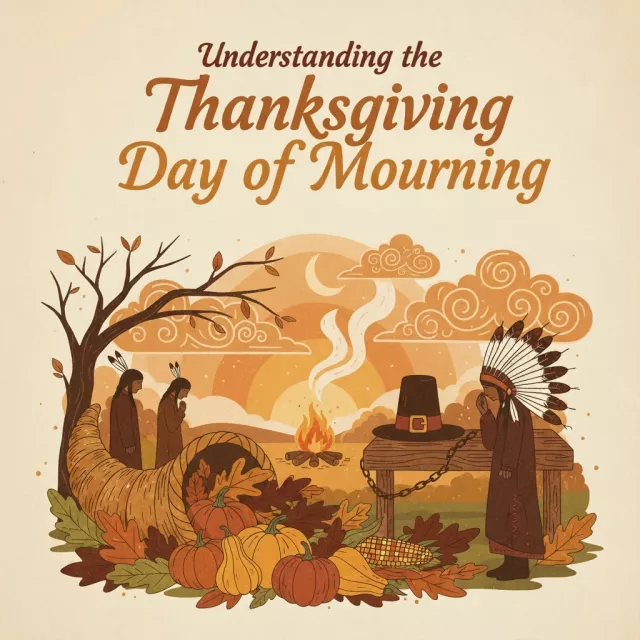
For a ready-to-use option built around respectful learning, Understanding the Thanksgiving Day of Mourning (digital download) is designed as an accessible Indigenous history guide and cultural awareness resource for teachers and learners. It can help build a learning sequence focused on remembrance, historical complexity, and present-day Indigenous realities.
If you want an optional add-on focused on mindset and reflection habits, the Positive Attitude Starter Pack (digital bundle) can be used by educators for planning reflective prompts or by older learners for independent routines that reinforce consistent writing and self-monitoring.
No. It is a separate observance that emphasizes remembrance and Indigenous perspectives on colonial history, often occurring on or around the same day as Thanksgiving.
Use place-based specificity, tribally preferred names, and Indigenous-authored sources when possible. Avoid costumes and reenactments, and include contemporary Indigenous life and sovereignty so students understand Indigenous nations as living communities.
The same resource can be adapted across age groups: younger students can use simplified prompts and guided discussion, while older students and adults can do deeper source analysis, writing tasks, and independent reflection.






Leave a comment