HomeBlogBlogFind Your Best Colors: Step-by-Step Color Analysis Toolkit

Find Your Best Colors: Step-by-Step Color Analysis Toolkit

Find Your Best Colors: Step-by-Step Color Analysis Toolkit

Finding Your Colors Step by Step: A Beginner Toolkit for Confident Outfit Choices

Color can make outfits look polished, skin look brighter, and shopping feel simpler—but only when the shades actually work with your natural coloring. The Finding Your Colors Step by Step Toolkit is built for beginners who want a clear, repeatable process using guides, eBooks, and checklists so outfit choices stop feeling like guesswork and start feeling consistent.

What changes when colors start working for you

When undertone, depth, softness/brightness, and contrast are in sync, the effect is noticeable—even with simple basics.

  • Outfits look more harmonious with less effort because tops, makeup, and accessories stop “fighting” your skin tone and hair color.
  • Getting dressed becomes faster when a personal palette reduces trial-and-error.
  • Shopping becomes more intentional: fewer “almost right” purchases and more wearable combinations.
  • Photos often look better when contrast and undertone are aligned, especially near the face.

If you’ve ever tried a “pretty” color and wondered why you looked tired, it’s usually not the color itself—it’s the mismatch in undertone, value (light/deep), or chroma (soft/bright). For a helpful primer on undertones and tone basics, the American Academy of Dermatology Association is a reliable starting point.

What’s inside the 10-in-1 toolkit bundle

A beginner-friendly system works best when it combines learning with action. This bundle is organized to help you identify what flatters and then apply it in your closet, your shopping cart, and your daily outfit formulas.

  • Step-by-step learning pieces that walk you through undertone, value (light/deep), chroma (soft/bright), and contrast.
  • Practical checklists that turn observations into decisions while decluttering, shopping, or building outfits.
  • Reference-style eBooks and guides you can revisit anytime a style shift, hair color change, or season change happens.
  • A structured system that helps translate “colors that flatter” into real wardrobe actions.

How each type of resource is used in real life

Toolkit piece Best time to use it Outcome
Quick-start guide Before you begin (30–60 minutes) Sets up lighting, comparison steps, and a simple decision path
Deep-dive eBooks When results feel unclear Explains why certain colors look off and how to correct course
Checklists Closet edits and shopping trips Turns preferences into consistent yes/no choices
Palette references Daily outfit building Speeds up coordination for tops, scarves, jewelry, and makeup shades

A simple beginner process that matches the toolkit

If you want a method you can repeat (and refine), use this flow. It’s designed to reduce confusion by focusing on comparisons instead of one-off “do I like this color?” judgments.

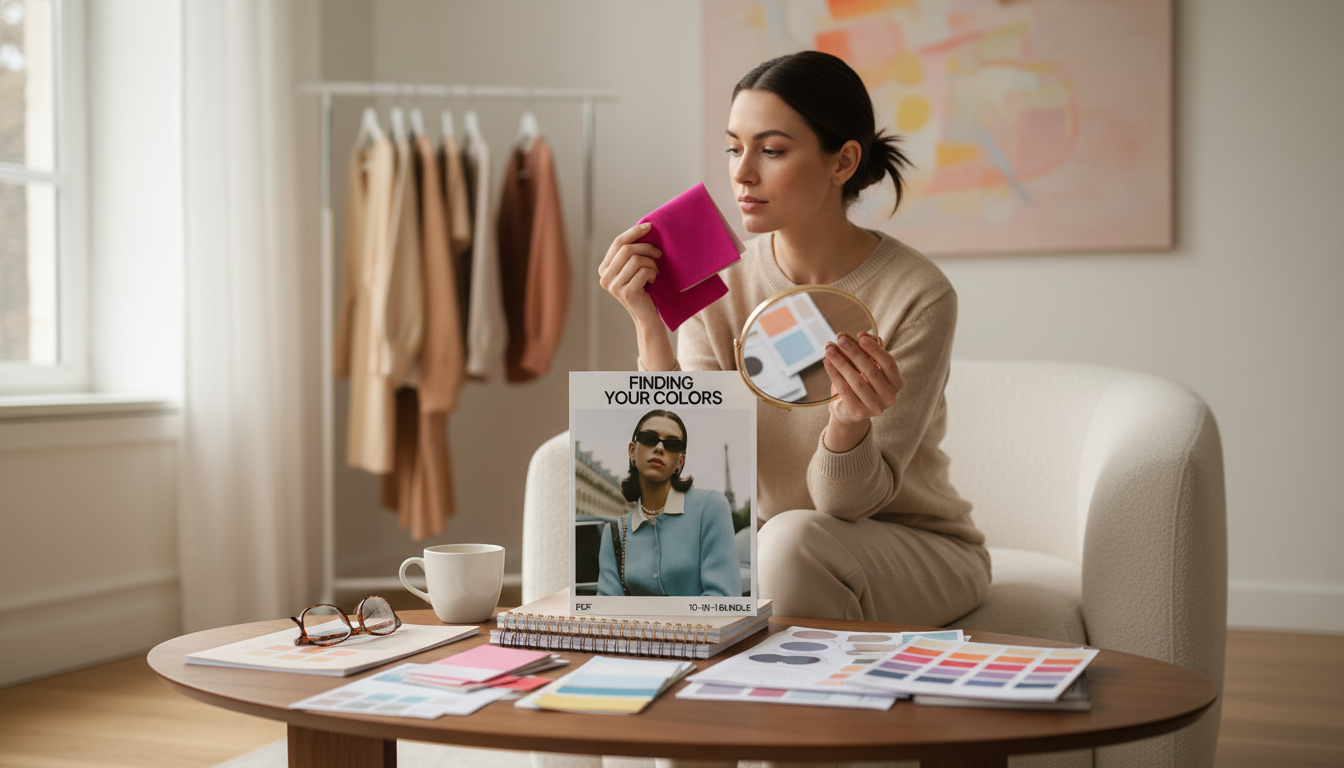
  1. Set up good conditions. Use neutral daylight when possible, wear minimal makeup, and put on a neutral top near the face to avoid color casting.
  2. Check undertone signals. Compare warm vs. cool influences near the face (gold vs. silver jewelry, creamy vs. stark white) and note which looks clearer and more even.
  3. Identify depth. Notice whether lighter shades or deeper shades feel more balanced and natural on you.
  4. Decide softness vs. brightness. Test muted, dusty colors versus clear, saturated colors to see which smooths features versus overwhelms them.
  5. Confirm contrast level. Compare low-contrast outfits to high-contrast combinations and observe which looks most cohesive.
  6. Translate to wardrobe rules. Choose 6–10 core neutrals, 6–10 best colors, and 2–4 accent shades for easy mixing.

If you enjoy understanding the “why” behind what you’re seeing, a quick overview of basic color concepts can also help you describe results more clearly. Britannica’s color theory overview provides useful background terminology.

Using the checklists to build a wardrobe that mixes easily

The fastest way to feel the benefits is to apply your results where they matter most: near your face, and in the colors you repeat weekly.

  • Start with face-framing items. Tops, scarves, and outerwear have the biggest impact on overall appearance, so they’re the best place to be selective.
  • Choose neutrals that match undertone and depth. When your neutrals align, the whole closet coordinates without forcing it.
  • Limit accent colors to a small set. Repeating a few accents across accessories creates cohesion with minimal effort.
  • Create a “safe” outfit formula. A reliable baseline (top + neutral bottom + one accent) builds confidence before experimenting with bolder pairings.
  • Use a shopping gate. If a color fails the checklist near the face, it becomes a “maybe later” instead of an impulse buy.

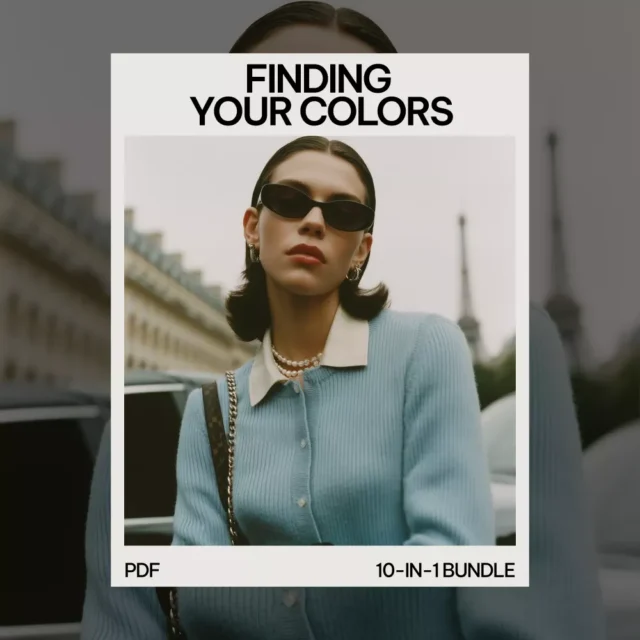
For a guided bundle that pairs learning with ready-to-use decision tools, keep your palette work in one place with the Finding Your Colors Step by Step Toolkit – 10-in-1 Color Analysis for Beginners Bundle.

Common beginner mistakes—and the fixes built into a step-by-step system

Confidence is a skill as much as a style outcome. If you’re also building consistency in habits and self-talk while you refresh your look, the Positive Attitude Starter Pack pairs well with a wardrobe reset because it supports follow-through—especially when you’re changing routines.

Who this bundle fits best

Getting started in one afternoon

FAQ

Can beginners accurately find their best colors without an in-person consult?

Yes. With consistent lighting, direct side-by-side comparisons, and decision checklists, beginners can reach reliable results and refine them over time as they test real outfits.

What if warm and cool both seem to work?

Move on to depth and softness/brightness next. Many people are close to neutral, so contrast and chroma guidance often creates clearer “this is it” results than forcing a strict warm/cool label.

Do hair color and tan change the results?

They can shift your best depth and contrast, especially near the face. Undertone tends to stay steadier, while seasonal tanning or a new hair color may change which shades look most balanced day to day.

Was this article helpful?

Yes No
Leave a comment

Top

Shopping cart

×