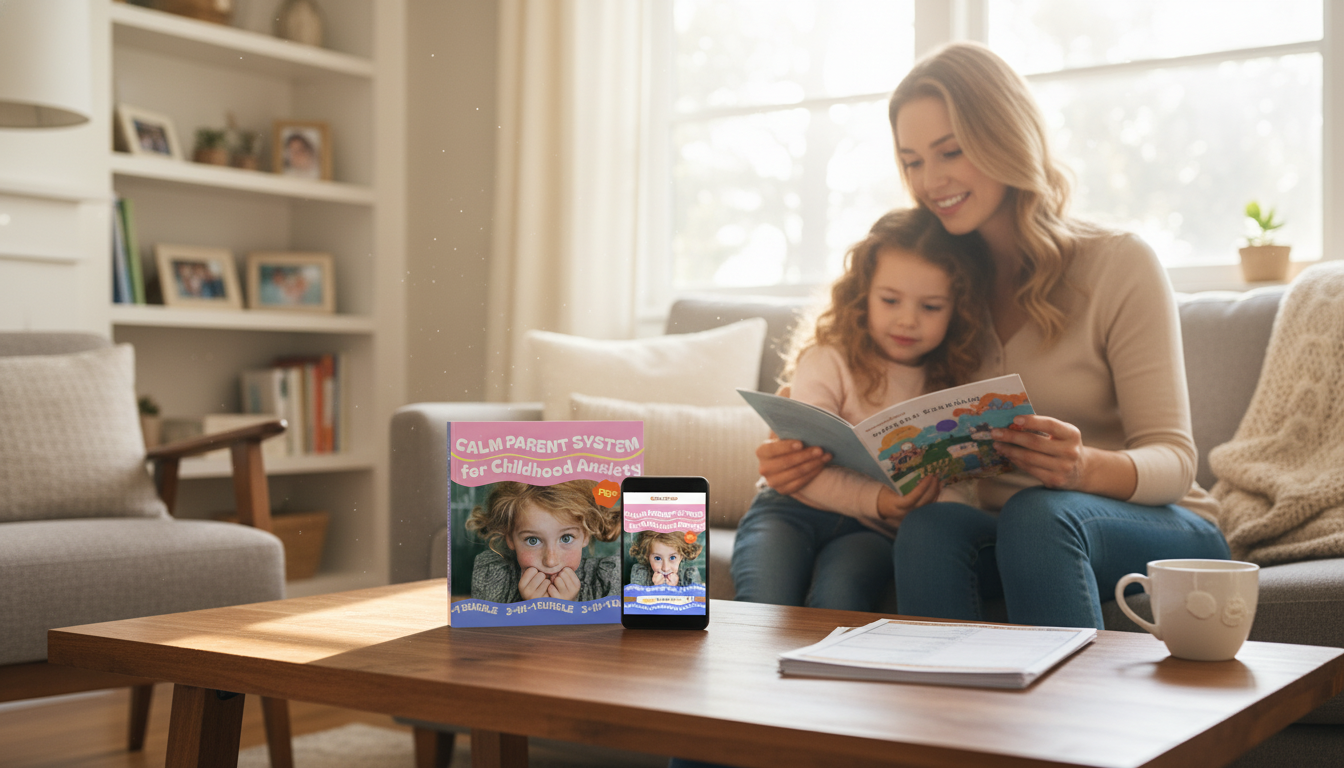
Childhood anxiety often shows up in everyday moments—bedtime worries, school drop-off tears, repeated reassurance-seeking, or sudden stomachaches before activities. A calm, repeatable parent approach can reduce escalation and build a sense of safety over time. This guide breaks down how a structured system—supported by step-by-step guides, quick-reference eBooks, and printable checklists—can help parents respond consistently, teach coping skills, and track patterns without turning every day into a negotiation.
Anxiety in kids doesn’t always look like “being scared.” It can show up as mood shifts, physical complaints, or behavioral standstills—especially when something feels uncertain.
If you’re unsure whether what you’re seeing “counts,” it can help to compare your child’s experience with reputable overviews such as the CDC’s information on anxiety and depression in children and the National Institute of Mental Health (NIMH) anxiety disorders resource.
When a child is anxious, the goal isn’t to find the one “magic sentence.” What helps more is a predictable, practiced response that reduces panic and builds capability.
That “system” mindset is also easier to share with other adults in your child’s life—partners, grandparents, babysitters, and teachers—so your child isn’t getting a totally different response depending on who’s on duty.
The Calm Parent System for Childhood Anxiety – 3 in 1 Bundle of Guides, eBooks & Checklists is built for real-life parenting: short attention spans, busy mornings, and the moments where you can’t pause to research what to say. The bundle combines deeper learning with quick tools you can actually use while you’re standing in the hallway or sitting at the bedside.
| Format | Best for | How it’s typically used |
|---|---|---|
| Guides | Building a baseline plan | Read in short sessions, then pick 1–2 routines to implement |
| eBooks | On-the-spot support and examples | Use as a quick reference for scripts, exercises, and coping ideas |
| Checklists | Consistency and accountability | Print or save; follow during transitions and review weekly |
| Moment | What to say (brief) | What to do (brief) | What to track |
|---|---|---|---|
| Bedtime worries | “Your brain is warning you; we can handle it.” | 2-minute breathing + plan tomorrow talk | Time to settle, repeated reassurance count |
| School drop-off | “I’m confident you can do hard things.” | Short goodbye ritual + teacher handoff | Tears duration, avoidance behaviors |
| Panic-like surge | “This will peak and pass.” | Grounding: 5-4-3-2-1 + slow exhale | Trigger, length, recovery tool used |
| Reassurance loop | “Asked and answered—now coping time.” | Limit reassurance + coping card + redirect | Number of repeats before settling |
For families who want an extra body-based option that fits well alongside coping scripts, the Yoga Techniques for Full Relaxation and Recovery: 4-in-1 Digital Download Bundle can be a helpful add-on for wind-down routines, tension release, and recovery after a stressful day.
For additional parent-friendly guidance on children’s emotional wellness, visit the American Academy of Pediatrics (AAP) mental health resources.
Many families notice fewer escalations within 1–2 weeks when they use the same scripts and routines consistently, especially during predictable triggers like bedtime or drop-off. More entrenched avoidance patterns often take longer, so tracking small wins (shorter recovery time, fewer reassurance repeats) helps show progress.
No—limiting reassurance means you validate the feeling without repeatedly “proving” the feared outcome won’t happen. Warmth and firmness can coexist: you can acknowledge discomfort (“This is hard”) and still guide a coping step (“Let’s do two slow exhales and follow the plan”).
These tools can be adapted from early elementary through the teen years by adjusting language, choices, and independence. Younger kids often do best with simple scripts and visual routines, while older kids and teens may prefer private coping options and collaborative planning.







Leave a comment