Master Copywriting for Your Offer: Turn a Good Product Into a Clear “Yes”
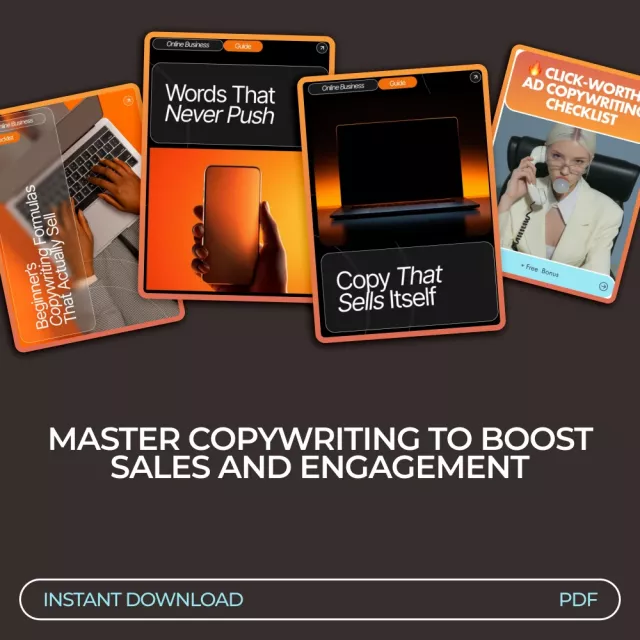
Strong copy doesn’t “sell harder”—it makes the offer easier to understand, easier to trust, and easier to choose. When buyers can quickly grasp what the product does, who it’s for, and what changes after they buy, they move forward with less hesitation. That’s the purpose behind the Master Copywriting for Your Offer: 4-in-1 Bundle of Copywriting Guides, eBooks & Checklists: a practical set designed to help shape your message, write clearer benefits, and assemble sales assets without endless second-guessing.
Instead of relying on hype or “clever” lines that don’t convert, this bundle supports a repeatable workflow—so the message stays consistent across landing pages, email sequences, and promotions.
What This Bundle Helps Improve
- Offer clarity: define the problem, the promise, and the outcome in plain language.
- Positioning: differentiate the offer without leaning on vague claims or overpromises.
- Customer understanding: translate features into real-life benefits and use-cases people recognize.
- Conversion flow: connect headline, lead, proof, and call-to-action so the page reads smoothly.
- Consistency: keep tone and message aligned across pages, emails, and ads.
Clearer copy also supports compliance-friendly marketing. If you reference results, comparisons, or testimonials, it helps to follow practical guidance like the FTC’s “Advertising and Marketing on the Internet — Rules of the Road”.
What’s Included in the 4-in-1 Set
- Guides for building a repeatable copy process from research to final draft.
- eBooks that explain frameworks for persuasive structure and reader-friendly clarity.
- Checklists to review key elements before publishing: promise, proof, objections, and CTA.
- Assets suited to typical marketing needs: landing pages, offer descriptions, email sequences, and promo copy.
- Digital-friendly materials you can reference during each writing session.
How Each Component Fits Into a Simple Copy Workflow
| Stage |
Goal |
Bundle resource to use |
Output |
| Discovery |
Understand audience pains and desired outcomes |
Guides + prompts |
Audience notes and angles |
| Structure |
Choose a persuasive flow that matches the offer |
eBook frameworks |
Page/email outline |
| Draft |
Write benefit-led copy with clear steps and proof |
Guides |
First draft copy |
| Refine |
Remove confusion and strengthen specificity |
Revision checklists |
Polished copy ready to publish |
| Quality check |
Confirm CTA, objections, and compliance-friendly language |
Final checklists |
Publish-ready assets |
Best-Fit Use Cases
- New offers that need a clearer promise and a stronger reason-to-believe.
- Existing sales pages that get traffic but don’t convert consistently.
- Email campaigns that feel repetitive or overly promotional.
- Creators building bundles, mini-courses, coaching packages, or digital downloads.
- Service providers who want better proposals, pitch pages, and onboarding emails.
If you publish online, it also helps to follow proven readability patterns—short sections, helpful headings, and straightforward language. Nielsen Norman Group’s guidance on writing for the web is a solid benchmark for clarity.
A Practical Way to Use the Bundle in One Week
- Day 1: Write a one-sentence offer promise and a short “who it’s for / who it’s not for” filter.
- Day 2: List top objections and match each with proof: testimonials, examples, guarantees, FAQs, or demos.
- Day 3: Draft headline sets (benefit-led, outcome-led, and problem-led) and select the clearest.
- Day 4: Build the core page flow: hook → problem → solution → benefits → proof → offer stack → CTA.
- Day 5: Draft a short email sequence that mirrors the page’s logic (awareness → proof → urgency/decision).
- Day 6: Run checklists, tighten language, and remove filler; make key claims more specific.
- Day 7: Publish, then track replies and questions to update FAQs and future messaging.
This approach keeps momentum high while still leaving room for real improvement. The goal isn’t perfection—it’s a cleaner message you can test, refine, and scale over time.
What to Look for in Strong Offer Copy
- Specific outcomes: clearly describable results instead of broad promises.
- Concrete benefits: what changes for the buyer in day-to-day life.
- Proof and credibility: examples, data points, testimonials, or a transparent explanation of the method.
- Objection handling: price, time, difficulty, and “will this work for me?” answered directly.
- Clean calls-to-action: one primary next step and minimal friction to purchase.
Helpful, people-first messaging also tends to hold up better over time, especially as platforms reward clarity and usefulness. Google’s overview of creating helpful, people-first content reinforces the same principle: be specific, be accurate, and prioritize the reader’s questions.
Recommended Add-Ons (In Stock)
If you’re building a business with multiple moving parts, these in-stock digital resources can complement a stronger offer message:
Product Details and Purchase Notes
FAQ
Is this bundle better for beginners or experienced marketers?
It supports both. Beginners get clear frameworks and checklists that reduce guesswork, while experienced marketers can draft faster and tighten revisions with structured quality checks.
Can the checklists be used for sales pages, emails, and ads?
Yes. The core elements—promise, benefits, proof, objections, and CTA—stay the same; the checklist simply helps you apply them consistently whether you’re writing a long-form page or a short ad.
How quickly can results be seen after updating copy?
Clarity improvements can be immediate, especially in headlines and the first screen of a page. Conversion changes usually depend on traffic quality, offer-market fit, and running clean tests over a few cycles.
Recommended for you






Leave a comment